Verbs Part 5
Verbs Part 5
Pi'el and Pu'al
Interactive Learning Module

Conjugation Patterns
1. Introduction
- This is the fifth module focusing on Biblical Hebrew verbs.
- The previous modules explored the conjugation patterns for verbs in the pa'al and nif'al binyanim.
- This module will turn to the pi'el binyan and its passive counterpart, the pu'al.
- Function – As we saw in the first module on verbs, the pi'el conjugation has a wide variety of usages. It might be factitive (indicating that an action causes someone to enter into a specific state),
For example, while the pa'al "קָדַשׁ" means "to be holy" or " to be set apart", the pi'el "קִדַּשׁ" means "to sanctify/consecrate (someone/something)". intensiive (indicating an intense action, in either force, number or duration), or privative (marking the absence or removal of a certain quality.For example, "לְשָׁרֵשׁ" means "to uproot". - Form – Verbs of both the pi'el and pu'al are characterized by the presence of a dagesh in their second root letter. Pi'el verbs generally have a chirik under the first radical in the perfect, and a patach in the imperfect and imperative, while pu'al forms are marked by a kubbutz under the first root letter in all conjugations.
- The module will introduce the various conjugations of both strong and weak verbs, providing a paradigm for each pattern with notes explaining the pattern and any unusual vocalization.
2. Pi'el – Perfect (Strong Verbs)
- The Paradigm – Click here for the perfect conjugation pattern of strong verbs (including those with gutturals) in the pi'el. [Bolded letters mark penultimate stress.]
Penultimate stress is when the accent falls on the second to last syllable. - Vowel pattern – Most strong verbs in the pi'el perfect conjugation have a chirik under the first root consonant and a patach stem vowel.
This refers to the vowel under the second root letter (excepting third person feminine and plural forms) . - The third person, masculine, singular form, however, can take either a tzere (hence the name פִּעֵל) or a patach as its stem vowel (שִׁלֵּם or שִׁלַּם).
Some words are attested to in Tanakh with both forms; others appear in Tanakh with one or the other. [Forms which take a patach in Biblical Hebrew are generally pronounced with a tzere in modern Hebrew.] - A select few roots, most notably כפר and דבר , exceptionally take a segol under the second root letter in the third person, masculine, singular (דִבֶּר).
However when these verbs are found at a pause (at the end of a verse or where marked by the etnachta cantillation mark), they take a pausal form with a tzere (דִבֵּר). - As with all verbs in the pi'el, there is a dagesh in the second root consonant. However, sometimes, in inflections where the second root letter takes a sheva, the dagesh will drop. (Compare בִּקֵּשׁ and בִּקְשׁוּ.) [When the second root consonant is one of the בגדכפ"ת letters, the dagesh does not drop; otherwise, however , there is no clear rule guiding when it is present or not.]
- I-Gutturals – I-Gutturals (including those with an aleph) follow the regular pattern and exhibit no abnormalities.
- II-Gutturals – As gutturals do not take a dagesh, roots with gutturals in the second root position exhibit one of two behaviors:
- Those with "ר" or "א" in the second root position demonstrate compensatory lengthening of the previous vowel (that under the first root letter) which changes from a chirik to a tzere (compare "שִׁלַּמְתִּי" and "בֵּרַכְתִּי").
- Those with ע, ח, or ה, do not get compensatory lengthening and follow the standard paradigm, simply without the dagesh.
- III-Gutturals – III-Gutturals (not including ל"ה and ל"א verbs), like I-gutturals, follow the regular pattern, but generally take a stem patach in the third person forms (שִׁלַּח).
However, when these verbs are found at a pause (at the end of a verse or where marked by the etnachta cantillation mark), they take a distinct pausal form, with a tzere and furtive patach (patterned like: "גִּדֵּע")ַ.

3. Pi'el – Perfect (Weak Verbs)
- The Paradigm – Click here for the perfect conjugation pattern of weak verbs (including those with gutturals) in the pi'el. [Penultimate stress is marked in bold.]
- The pi'el conjugations of weak verbs in the perfect is not significantly different than that of their strong counterparts.
- פ"י, פ"נ and ע"ע verbs – Weak verbs of the פ"י, פ"נ and ע"ע classes are not irregular and follow the paradigm for strong verbs, with none of the root vowels dropping or assimilating.
- ל"א verbs – ל"א verbs exhibit expected changes, with the aleph quiescing and the previous vowel lengthening to a tzere. Singular third person forms might alternatively take a kamatz under the second root letter (מִלֵּא or מִלָּא).
- ל"ה verbs – ל"ה verbs behave similarly to the way they do in the kal and nif'al. Third person singular forms take a kamatz-heh ending. In first and second person forms, the heh drops and is replaced by yud, with the second root consonant taking a chirik. First person forms might alternatively take a tzere-yud. [Compare "צִוִּיתִי" and "צִוֵּיתִי".]
- Hollow roots are very rare in the pi'el, and are thus not included in the discussion here.

4. Review Exercise
- Conjugate the following roots in the pi'el perfect and check yourself by finding the root in the linked verse:
- גדל (3ms) - Yehoshua 4:14
- חלל (2mp) - Yechezkel 36:22
- ענה (2ms) - Tehillim 88:8
- חזק (1cs) - Tehillim 88:8
- חרף (2mp) - Shofetim 8:15
- כסה (3fs) - Bereshit 38:15
- טהר (1cp) - Divrei HaYamim II 29:18
- מלא (3cp) - Bemidbar 32:11
5. Pi'el – Imperfect (Strong Verbs)
- The Paradigm – Click here for the imperfect conjugation pattern of strong verbs (including those with gutturals) in the pi'el. [Bolded letters mark penultimate stress.]
Penultimate stress is when the accent falls on the second to last syllable. - Vowel pattern – Strong verbs in the imperfect conjugation follow the "יְשַׁלֵּם" vowel pattern, with a sheva (or chataf) under the prefix, a patach under the first root consonant and a tzere under the second root letter.
- As with all verbs in the pi'el, there is a dagesh in the second root consonant. However, sometimes, in inflections where the second root letter takes a sheva, the dagesh will drop. (Compare "יְבַקֵּשׁ" and "יְבַקְשׁוּ").
- I-Gutturals – I-Gutturals (including those with an aleph) follow the regular pattern.
- II-Gutturals – As above, since gutturals do not take a dagesh, roots with gutturals in the second root position exhibit one of two behaviors:
- Those with "א" or "ר" in the second root position demonstrate compensatory lengthening of the previous vowel (that under the first root letter) which changes from a patach to a kamatz (יְבָרֵךְ). In addition, any gutturals which would otherwise take a sheva take a chataf.
- Those with ע, ח, or ה, do not get compensatory lengthening and follow the standard paradigm, but replace shevas with chatafs.
- III Gutturals – III Gutturals (not including ל"ה and ל"א) also follow the regular pattern, but take a stem patach (יְשַׁלַּח) throughout the inflection (rather than the tzere taken by other roots).
When these verbs take a pausal form, the tzere reappears, following the pattern of "יְשַׁלֵּחַ". - ו"ו ההיפוך – When the pi'el imperfect forms follow a ו"י ההיפוך, the initial yud of third person forms loses its vowel (the sheva is silent) and does not get the usual doubling of the ו"ו ההיפוך forms. For example, see: "וַיְשַׁלַּח" and "וַיְשַׁלְּחוּ" without a dagesh in the yud.

6. Pi'el – Imperfect (Weak Verbs)
- The Paradigm – Click here for the imperfect conjugation pattern of weak verbs in the pi'el. [Penultimate stress is marked in bold.]
- The pi'el conjugations of weak verbs in the imperfect are not significantly different than that of their strong counterparts.
- פ"י, פ"נ and ע"ע verbs – Verbs of the פ"י, פ"נ and ע"ע classes follow the paradigm for strong verbs, with none of the root vowels dropping or assimilating.
- ל"א verbs – ל"א verbs are very similar to the regular paradigm, except that the aleph is silent and second and third person, feminine, plural forms take a segol stem vowel (תְּמַלֶּאנָה) rather than a tzere.
- ל"ה verbs – ל"ה verbs behave similarly to the way they do in the kal and nif'al. All forms without an inflectional suffix take a segol-heh ending (תְּצַוֶּה). In forms with a suffix, the heh drops before the ending (תְּצַוִּי), and in the second and third person feminine plural forms the heh is replaced by a yud and the stem vowel is a segol (תְּצַוֶּינָה).
- Hollow roots are very rare in the pi'el, and are thus not included in the discussion here.

7. Review Exercise
- Conjugate the following roots in the pi'el imperfect and check yourself by finding the root in the linked verse:
- שבר (2ms) - Shemot 23:24
- חלל (3mp) - Vayikra 22:15
- ענה (2ms) - Shemot 22:22
- חזק (1cs) - Shemot 4:21
- פאר (3ms) - Tehillim 149:4
- ברך (1cp) - Tehillim 115:18
- גדע (3ms with ו"ו ההיפוך) - Divrei HaYamim II 14:2
8. Pi'el – Partial Conjugations
- This slide will explore the forms of imperatives, infinitives, and participles.
- Imperatives – Pi'el imperatives (of both strong and weak verbs) are generally identical to second person imperfect forms, but without the prefix. One exception are roots from the ל"ה class whose masculine singular form takes a tzere-heh ending (צַוֵּה) rather than the segol-heh of the imperfect. See here for a paradigm.
- Infinitive construct – The infinitive construct is generally identical to the masculine, singular imperative. Here, too, the main exception is the ל"ה class of roots which take an "ות" ending (צַוּוֹת).
This should be familiar from the kal and nif'al. See here for a paradigm. - Infinitive absolute – The infinitive absolute in the pi'el follows the pattern "שַׁלּוֹם". When "ר" or "א" is the second root letter, there is compensatory lengthening of the initial vowel (בָּרוֹךְ) and when gutturals are in the final position, they take a furtive patach (שַׁלוֹחַ). On the whole, however, infinitive absolutes are pretty rare in the pi'el, and the infinitive construct is often used in its place. See, for example, the phrase "שַׁלֵּחַ תְּשַׁלַּח" in Devarim 22:7 (and not "שַׁלֹּוֹחַ תְּשַׁלַּח"). See here for a paradigm.
- Participles – The stem of the participle matches the imperfect form, but is prefixed with a mem. Verbs of the ל"א and ל"ה classes exhibit expected changes. See here for a paradigm.
- Review Exercise – Conjugate the following and check yourself by finding the root in the linked verses:
- דבר (Imperative, mp) - Shemot 12:3
- צוה (Participle, fs) - Bereshit 27:8
- דבר (Participle, fp) - Yeshayahu 19:18
- טהר (Infinitive construct) - Yechezkel 39:12


9. Pu'al – Perfect (All Verbs)
- This and the next slide will turn to the pu'al conjugation pattern which is very similar to that of the pi'el.
- The Paradigm – Click here for the perfect conjugation pattern of pu'al verbs. [Bolded letters mark penultimate stress.]
- Vowel pattern – Most verbs in the pu'al perfect conjugation have a kubbutz under the first root consonant and a patach under the second root letter throughout the inflection. There is a dagesh in the second root consonant. [As above, in inflections where the second root letter takes a sheva, the dagesh sometimes drops.]
See Ibn Ezra on the word "לֻקְחָה", a pi'el form which lacks the dagesh. - I-Gutturals and III-Gutturals – These follow the regular pattern and exhibit no irregularities.
- II-Gutturals – As gutturals do not take a dagesh, roots with gutturals in the second root position exhibit one of two behaviors, just as in the pi'el:
- Those with "ר" or "א" in the second root position demonstrate compensatory lengthening of the previous vowel (that under the first root letter) which changes from a kubbutz to a cholam (compare שֻׁלַּמְתִּי and בֹּרַכְתִּי).
- Those with ע, ח, or ה, do not get compensatory lengthening and follow the standard paradigm, simply without the dagesh.
- פ"י, פ"נ and ע"ע verbs – Weak verbs of the פ"י, פ"נ and ע"ע classes are not irregular and follow the paradigm for strong verbs, with none of the root vowels dropping or assimilating.
- ל"א verbs – ל"א verbs exhibit expected changes, with the aleph becoming silent and the previous vowel lengthening to a tzere (מֻלֵּאתִי). [Singular third person forms instead take a kamatz under the second root letter (מֻלָּא).]
- ל"ה verbs – ל"ה verbs also exhibit expected changes. Third person singular forms take a kamatz-heh ending (צֻוָּה). In first and second person forms, the heh drops and is replaced by yud, with the second root consonant taking a tzere (צֻוֵּיתָ).

10. Pu'al – Imperfect and Partial Conjugations
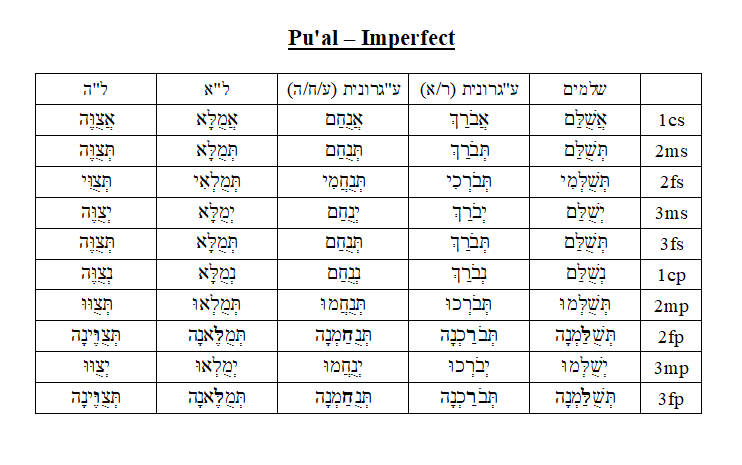
- The Imperfect Paradigm – Click here for the imperfect conjugation pattern of pu'al verbs.[Bolded letters mark penultimate stress.]
- Vowel pattern – Verbs in the imperfect conjugation generally follow the "יְשֻׁלַּם" vowel pattern, with a sheva (or chataf) under the prefix, a kubbutz under the first root consonant and a patach under the second root letter. There is a dagesh in the second root consonant. [As above, in inflections where the second root letter takes a sheva, the dagesh sometimes drops.]
- I-Gutturals and III-Gutturals – These do not exhibit any abnormalities.
- II-Gutturals – As above, since gutturals do not take a dagesh, roots with the gutturals in the second root position exhibit one of two behaviors:
- Those with "א" or "ר" in the second root position demonstrate compensatory lengthening of the previous vowel (that under the first root letter) which changes from a kubbutz to a cholam . In addition, any gutturals which would otherwise take a sheva take a chataf
- Those with ע, ח, or ה, do not get compensatory lengthening and follow the standard paradigm, but replace shevas with chatafs.
- פ"י, פ"נ and ע"ע verbs – Verbs of the פ"י, פ"נ and ע"ע classes follow the paradigm for strong verbs, with none of the root vowels dropping or assimilating.
- ל"א verbs – ל"א verbs are very similar to the regular paradigm, except that the aleph is silent and second and third person, feminine, plural forms take a segol stem vowel (תְּמֻלֶּאנָה) rather than a patach.
- ל"ה verbs – ל"ה verbs behave similarly to the way they do in other binyanim. All forms without an inflectional suffix take a segol-heh ending (תְּצֻוֶּה). In forms with a suffix, the heh drops before the ending (תְּצֻוִּי), and in the second and third person feminine plural forms the heh is replaced by a yud and the stem vowel is a segol (תְּצֻוֶּינָה).
- Imperatives and Infinitives – Imperative and infinitive forms of the pu'al are rarely attested to in Tanakh.
- Participles – The stem of the participle matches the imperfect form, but is prefixed with a mem. Weak verbs and gutturals exhibit expected changes. See here for a paradigm.

11. Review Exercise
- Conjugate the following roots in the pu'al and check yourself by finding the root in the linked verse:
- שדד (perfect, 3fs/3cp) - Devarim 7:5
- ברך (participle, fs) - Devarim 33:13
- כסה (imperfect, 3ms) - Kohelet 6:4
- יסד (participle, mp) - Shir HaShirim 5:15
- הלל (imperfect, 3ms) - Mishlei 12:8
- צרע (participle, ms) - Melakhim II 5:1
- שלח (perfect, 3ms) - Shofetim 5:15
12. Comparing Binyanim - Review Exercises
- 1) Similar forms – Compare the word "שִׁלְחוּ" in Bereshit 42:16 and "שִׁלְּחוּ" in Shofetim 1:8. What is the difference in meaning? What binyan and conjugation (perfect, imperfect, imperative etc.) is each? How do you know?
The word "שִׁלְחוּ" is an imperative (command) form in the pa'al, while "שִׁלְּחוּ" is a perfect verb form in the pi'el, marked by the dagesh in the second root letter. Compare also the word "מִלְאוּ" in Melakhim I 18:44 and Melakhim I 20:27. What binyan is each?Here, too, one is a pa'al command form, and one is in the pi'el; the two forms look identical only because this is an example where the dagesh has dropped from the pi'el. - 2) "קול ענות" – Read Shemot 32:18 and find the three occurrences of the root "ענה". How do the forms differ?
- All three words are in the infinitive construct but not all are of the same binyan. Which are in the pa'al and which in the pi'el?
- See Rashi who uses this distinction to explain the third occurrences of the root differently than the first two; what does he suggest is the meaning of the pi'el form as opposed to the pa'al forms?
- 3) תִּשְׁקֹר vs. תְּשַׁקֵּר – Use the concordance to scan the various usages of the root "שקר" in Tanakh. Almost all occurrences are in the pi'el; which verse is the exception?
- See Ibn Ezra on Bereshit 21:23 who notes this, and see R. Yitzchak Shemuel Reggio for an explanation of the difference in meaning when the word appears in the pa'al and pi'el.
13. For Further Study
- Return to the beginning of this module.
- Click here to proceed to the next module on verbs, which will explore the hif'il and huf'al conjugation patterns.
- Access additional grammar topics and modules.
- Access additional Interactive Learning Modules.