Verbs Part 1
Verbs Part 1
Introduction
Interactive Learning Module

Verbs
1. Introduction
- This is the first of several interactive modules relating to Biblical Hebrew verbs. The unit will introduce several grammatical concepts necessary for understanding the Hebrew verbal system:
- Roots – All Hebrew verbs are built from a core "root" which comprises the verb's basic meaning. These roots are inflected
This refers to a change in the form of a word (through the addition of a prefix or suffix or a change in vocalization) to express different grammatical functions or categories like tense, number, or gender. by adding prefixes and suffixes or changing vocalization, creating new forms with specialized meaning. - "בנינים" – Hebrew has seven main binyanim
The word literally means "buildings" or "construction". or verbal patterns (פָּעַל, נִפְעַל, פִּעֵל, פֻּעַל, הִפְעִיל, הֻפְעַל, הִתְפַּעֵל). Each is used to an indicate a certain voice (whether something is passive, active or reflexive) and specific modes of action (simple, causative, intensive, iterative and the like). - Conjugations – Verbs from each of the binyanim can be conjugated in a number of different ways. Some forms (the perfect and imperfect) express tense (past, future) and aspect (whether an action is perceived as complete or ongoing), others (the imperative, jussive and cohortative) express mood (whether the speaker is stating a fact, desire, or command), and others (participles and infinitives) are used to create verbal nouns or adjectives (as in the phrases: "studying is important" or: "the sleeping baby".)
- Each of the above concepts will be elaborated upon and explained in the coming slides.
2. Opening Questions
- As we explore the concepts of roots, binyanim (verbal patterns), and conjugations in this unit, we will attempt to answer the following questions:
- How does the Hebrew verbal system differ from the English system? What are the advantages and disadvantages of each?
- Why, for example, does Hebrew have so many different forms for every verb? [While an English verb usually takes no more than a handful of different forms (eat, eats, ate, eaten, eating), in Hebrew one might have dozens of different inflections for a single root!]
- When is each of the seven verbal patterns (בנינים) used and what specific meanings are attached to verbs inflected in any given pattern?
- For example, what is the difference in meaning when a verb is inflected in the pi'el as opposed to the hif'il or the nif'al as opposed to the pu'al? Is there a difference in connotation between קִדַּשׁ (in the pi'el form) and הִקְדִּישׁ (in the hif'il), between "נִלְקַח" (nif'al) and "לֻקָּח" (pu''al), or between צִחֵק (in the pi'el form) and צָחַק (in the pa'al)?
- When looking at a verb, how can one tell which binyan, tense, or mood it is in? What are the markers one should look for?
3. Verbal Roots
- Tri-consonantal roots – Today, it is commonly accepted that the vast majority of Biblical Hebrew verbs are based on tri-consonantal roots (שרשים)
For historical background regarding the development of the tri-consonatal theory and the debate over whether roots comprise two or three letters, see Roots. which encapsulate the basic meaning of the verb and to which prefixes and suffixes are added to mark person, gender etc. [It should be noted, however, that the root itself is a grammatical abstraction and does not exist independently in the Biblical text.] - For example, the root "כתב" lies at the base of all the following verbs: כָּתְבוּ, אֶכְתְּבֶנָּה, כָּתַבְתִּי, תִּכְתְּבוּ and תִּכָּתֶב, each relating to "writing".
- Finding the root – Generally, the root of a word can be found by stripping away all its inflectional elements. These will usually be one or more of the seven consonants in the mnemonic האמנתי"ו. [These seven letters are those generally added as prefixes or suffixes to verbs when they are conjugated.]
- For example, to find the root of "וְהִתְקַדִּשְׁתֶּם", one strips away the ו, ה, ם and double ת, leaving the root "קדש".
On AlHaTorah.org, if one wants to check the root of any word in the Biblical text, one can simply click on the word in the Mikraot Gedolot, and choose concordance from the dropdown menu. The root will appear in the input bar. - Weak verbs – Sometimes, when a word is inflected, some of its root letters get lost, assimilated,
Assimilation refers to a linguistic process in which a letter's sound is modified or disappears due to the influence of a neighboring sound. It might be absorbed by the following one (as often happens with the letter נ) or sound more similar to it (as when a "ת" becomes a "ד" in certain hitpa'el conjugations). An example of assimilation can be found in the English word "immoral" (in + moral = immoral). or vocalized irregularly. Verbs with such letters are called "weak verbs", and the consonants "weak consonants". [Verbs which maintain their root letters across inflection are, in contrast, called "strong" or "regular" verbs.] - Letters that often "disappear" include those in the mnemonic "יונה" and doubled root letters (as in the root סבב). When verbs with these letters are inflected, the root might not be immediately identifiable.
- For example, the root "ישב" is considered weak, with the initial "י" being lost in many inflections. Thus, though all the verbs נוֹשָׁבָה לָשָׁבֶת, אֵשֵׁב, הוֹשִׁיב, יָשַׁבְתּ relate to the root, the initial "י" is found in only one of the forms.
- Sometimes a root might have two weak letters which both get lost.
- For example, when the root "נטה" is inflected for the third person singular, we find "ויט" which preserves just one root letter.
- At other times, as often happens when one of the letters אהו"י is part of the root, a consonant might appear in the inflection, but be unvocalized, or alternatively, be replaced by a different vowel letter.
- For example, when the root "קום" is inflected for the third person singular, we find "יָקוּם" where the "vav" acts as a vowel letter and not a consonant.
- When the root "ישב" is inflected to become a causative, it turns into "הוֹשִׁיב", with a vav replacing the yud.
- Finally, gutturals (אהח"ע) are also referred to as "weak" even though many of them are retained even when inflected, yet they nonetheless behave irregularly, causing vocalization changes in expected patterns.
4. Classifying Roots
- Root Position – As roots which have weak letters in the same positions tend to act alike, it is helpful to classify roots based on the position of the letter within the root. One can thus refer to a letter as being in the Root I, II or III position (from right to left), or by assigning each consonant a place based on the word "פעל" ("he acted"). The first letter of the root is assigned to "פ", the second to "ע" and the third to "ל".
The choice of the word "פעל" to serve as a prototype was a result of borrowing from Arabic which uses the synonym "fa'ala" (فَعَلَ) for the same purpose. Both roots mean "to do", appropriate for verb formation. In Hebrew, though, the choice turned out to be less than ideal since "ע" is a guttural which acts irregularly in conjugations, making it inappropriate for demonstrating certain forms. [In Arabic this was not an issue since the guttural did not take unique forms]. As such, many modern grammars instead use the verbs "קטל" or "פקד" as prototypes as these contains no weak letters and can thus more easily demonstrate various conjugations. We will generally use the traditional "פעל" to indicate root position, but utilize the other roots as paradigms for inflections when necessary to obviate the possibility of irregularity. - For example, a פ"א verb is one which opens with an "א", while an ע"ו verb is one with a "ו" as the second radical.
- גזרה - Each family of roots which share the same inflection patterns (פ"י, ע"ו, ל"ה etc.) is referred to as a "גזרה" (morphological class). The main categories follow:
- גזרת השלמים (the complete class) - This group includes all those roots which maintain their root letters throughout inflections, what we referred to above as "strong" or "regular" verbs.
- Examples include: שמר, למד, פקד, כתב , מסר and more.
- גזרות נחות (silent classes) - These families of roots include those which contain one of the אהו"י letters and are marked by the fact that in at least some inflections, these weak letters will appear but be silent. [Sometimes they might instead appear as an alternative vowel letter, with a "י" becoming a "ו" or a "ה" becoming a "י". In other inflections they might be either pronounced or dropped totally.]
When dropped, the missing letter is not marked by a dagesh. Included in the גזרות נחות are the following subgroups:- a) פ"א roots - Only some roots beginning with "א" fall into this category (אפה, אמר, אכל, אבד, אבה, אחז, אהב).
The majority are regular verbs whose "א" is consonantal when the verb is inflected. When these roots are inflected, though the "א" is pronounced in some cases (אָמַרְנוּ), in others it appears as a silent vowel letter (תֹּאמַרְנָה, יֹאמְרוּ). - b) פ"י/פ"ו roots (ידע, ישב, ירד, יטב) - In certain inflections the yud is found but silent (הֵיטַבְתְּ); elsewhere it appears as the vowel vav (הוֹדִיעַ ,הוֹרַדְתֶּם)
This is why the class is referred to as both פ"י and "פ"ו verbs. or is totally dropped (אֵרֵד). [It might also simply be pronounced (יָרַדְתִּי).] - c) ע"י or ע"ו roots (קום, בוא, שיר) - These are sometimes also referred to as "hollow roots". In some inflections, the yud or vav appear but are silent (אָשִׂים, תָּקוּם); in others they drop totally (קָם, שַׂמְנוּ).
- d) ל"א roots (מצא, קרא, ברא) - The "א" is silent across many inflections (מְצָאתֶם, נִמְצֵאתִי), though elsewhere it might be vocalized (מָצְאָה).
- e) ל"י/ל"ה roots (בנה, ראה, פנה) - In some inflections the heh will be found but silent (אֶרְאֶה,תִּבְנֶה), while elsewhere it will appear as a silent yud (בָּנִיתִי, רְאִיתִם)
This is why the class is referred to as both ל"י and ל"ה verbs. or be lost (בָּנוּ).This category does not include all roots ending in heh, only those where the heh functions as a vowel letter when inflected. In other roots, the heh is consonantal and pronounced throughout the inflection. Compare the weak בכה which becomes בָּכוּ (losing the heh) and the strong גבה which becomes גָּבְהוּ, maintaining its heh.
- a) פ"א roots - Only some roots beginning with "א" fall into this category (אפה, אמר, אכל, אבד, אבה, אחז, אהב).
- גזרות חסרות (absent classes) - Roots of these categories will all have some inflections in which the weak consonant is dropped (absent). In contrast to the above, however, the letter's absence will be marked by a dagesh chazak in the following root letter (unless that letter cannot take a dagesh).
If the following root letter is a guttural or finds itself at the end of a word it will not get a dagesh. The חסרות have two sub-classes: - פ"נ roots (נסע, נבל, נטע)
- פ"יצ roots (those where the first root letter is י and the second is צ, such as יצר, יצק, יצג)
- גדרת הכפולות (פע"ע) – Roots of this category are marked by having a doubled root letter (דלל, ארר, סבב). As in the absent classes, they will all have some inflections in which the weak consonant is dropped and its absence is marked by a dagesh chazak (דַלּוֹנוּ, גַנּוֹתִי).
- גזרות גרוניות - These include all roots which contain a guttural (אהח"ע) in one of the three positions. These will often cause exceptional vocalization.
5. Finding Roots: Exercise
- Strong verbs – Find the roots of each of the following strong verbs, those whose roots letters do not get lost when inflected. Check yourself by clicking on the link, finding the word, and clicking on it to see its dictionary entry.
- וּשְׁמַרְתֶּם (Shemot 12:17)
- וְנִפְקַדְתָּ (Shemuel I 20:18)
- וַיִּכְתְּבוּ (Shemot 39:30)
- Weak verbs – Find the roots of each of the following weak verbs. [Remember that one or more letters of the root (יונ"ה) might not appear in the inflection. If needed, click on the footnotes for hints as to which גזרה each falls into.]
- וַיִּשָּׂא
This is a פ"נ verb. (Bereshit 13:10) - עָנִיתָ
This is a ל"ה verb. (Devarim 26:5) - בְּמֹצַאֲכֶם
This is a ל"א verb. (Bereshit 32:20) - בְּהוֹצִיאֲךָ
This is a פ"י verb. (Shemot 3:12) - אֲרוֹמְמֶךָּ
This is an ע"ו verb. (Tehillim 118:28) - לְהִתְפַּלֵּל
This is an ע"ע verb. (Yeshayahu 16:12) - וַיַּךְ
This is a doubly weak verb. (Shemot 2:12) - סֹלּוּ
This is an ע"ע verb (Yeshayahu 57:14)
6. Verbal Properties
- As we have seen, though a word's root will comprise its basic meaning, the various prefixes, suffixes, and distinct vocalizations that it takes when inflected provide more information about the verb. These might convey data about the subject of the verb, the duration and nature of its action, the intent of the actor and more.
- As such, Hebrew has many different inflections for any given verb. This stands in contrast to English, where verbs have a relatively limited number of forms.
- For example, while the word "walk" has only four forms (walk, walks, walking, and walked), the Biblical Hebrew equivalent "הלך" takes over 200 forms!
- Following is a list of verbal properties which are expressed in Hebrew through a verb's inflection (with comparisons to how English might convey the same ideas):
- Person, Number, Gender – Hebrew verbs agree with their subject in number (plural or singular), gender (masculine or feminine) and person (1st – I, we, 2nd – you, 3rd – s/he, they), necessitating a different verbal form for each.
Though this is a general rule, there are many exceptions where one does not see correspondence. See Number and Gender for many examples. - Thus, in contrast to English where one would use the same verbal form "wrote" regardless of whether the subject is "I", "we", "you", "s/he" or "they",
In English, throughout its tenses, most forms are the same regardless of the subject, with the exception of third person present tense verbs (I/you/we/they "write", but s/he "writes"). in Hebrew, the root ("כתב") would be inflected differently for each subject: אֲנִי כָּתַבְתִּי, אַתָּה כָּתַבְתָּ, הוּא כָּתַב etc. - As the verb contains information about its subject, in contrast to English, often the subject need not even be mentioned explicitly and the verb can stand alone. For example, "לָמָּה לֹא הָלַכְתָּ עִמִּי" (Shemuel II 19:26) means: "Why didn't you go with me" even though the pronoun "you" is not mentioned.
- Voice – Grammatical voice refers to the relationship between a verb and its subject, indicating whether the subject performs the action (active voice), is acted upon (passive voice), or both performs and receives the action (reflexive or reciprocal voices).
- Examples: He washed his hands (active). His hands were washed (passive). He washed himself (reflexive). They washed each other (reciprocal).
- While in English the verb might have an identical form in all four voices ("washed"), in Hebrew, the verb is inflected differently for each voice.
- Example: הוא רחץ את ידיו (active). ידיו נרחצו (passive). הוא התרחץ (reflexive).
- Action – Verbs can be classified by the type of action performed, being simple, intensive, causative, repetitive etc. English often conveys intensity or iterative actions through the use of adverbs or strong synonyms
For example, one might say: "he ran fast" or "he sprinted". and shows causality through helping verbs.For example, one might say, "I had him go to the store" or "I made him drink". Here, too, Hebrew will instead simply inflect the same verbal root in different ways to convey the various ideas. - Mood – This refers to a specific set of verbal forms used to express the attitude of the speaker towards his subject, indicating whether his words are a statement of fact, a wish, or a command etc. In English, these ideas are conveyed through auxiliary verbs such as "may", "can", "let" or "shall", while in Hebrew these, too, are expressed through verbal inflection.
- Thus, "יֵלֵךְ" means "He will go" (fact) "לֵךְ" means "Go!" (command), and "אֵלְכָה" means "Let me go" (desire).
- Tense and Aspect – Finally, in Biblical Hebrew, verbs are marked for a combination of tense (past, future) and aspect (indicating whether an action is perceived as completed or incomplete/ongoing). The former is referred to as the "perfect" and the latter as the "imperfect", often translating into English as the past and future respectively.
This is a somewhat simplified formulation; we will elaborate further in coming slides.
7. Binyanim
- Seven binyanim – Hebrew has seven main binyanim or verbal inflection patterns, sometimes referred to as verbal stems (as opposed to roots): פָּעַל, נִפְעַל, פִּעֵל, פֻּעַל, הִפְעִיל, הֻפְעַל, הִתְפַּעֵל. [The name of each pattern comes from the third person masculine singular form of that pattern.]
Not all medieval grammarians counted seven binyanim. See Ibn Ezra who counts just six, combining the two passive binyanim, the pu'al and hof'al, into one category, referring to both as those "שלא נזכר שם פועלו" (whose actor is not mentioned; i.e. which are passive). Interestingly, he does not categorize the nif'al together with these, suggesting that he does not view it as a primarily passive stem. He discusses the various binyanim mainly with regards to their morphological features, referring to the pa'al as "קל" (simple), as it has no added letters, the hif'il as "כבד נוסף" as it is marked by the addition of a "ה" to its root, and the pi'el as "כבד" (or "כבד דגוש") as it is marked by a dagesh. See also Radak (Mikhlol p. 69 ff.), following Hayyug and others, who counts eight stems, the seven listed above and an eighth, the "פּוֹעֵל", which relates mainly to hollow roots (גזרת ע"ו) and ע"ע roots which take the form "קוֹמֵם" or "סוֹבֵב". [He discusses there both the form and function of the various binyanim; some of his conclusions will be brought in the notes in the coming slides.] - Verbs of the same root will share a core meaning throughout the different binyanim, but have different voices (active, passive or reflexive) and express the action of the verb differently (being either simple, causative, intensive, iterative etc.). As such, the same root takes on several different nuances of meaning depending on the stem.
The verbs of each binyan then stand alone, each being conjugated independently for person, number and gender in each of the perfect, imperfect etc. conjugations. - In this and the coming slides we will introduce some of the possible meanings of each binyan, some identifying features, and how the different binyanim relate one to another. Later modules will focus on the actual inflection patterns of each stem.
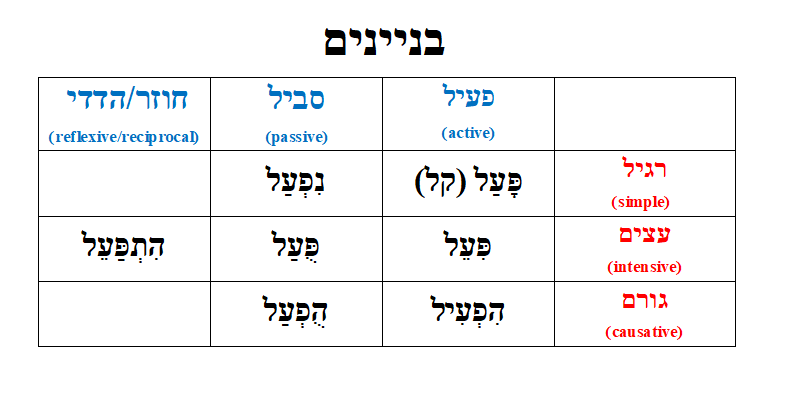
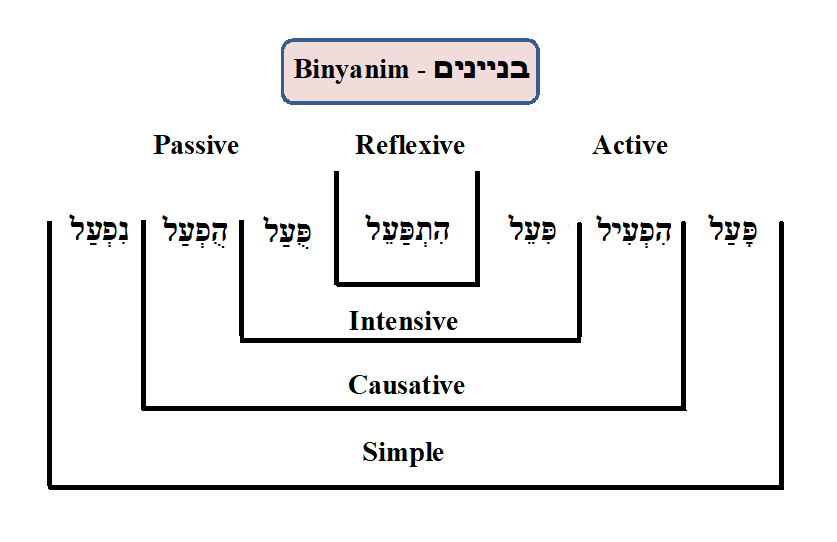
- Overview – Often, when describing the various binyanim, they are presented according to the attached table or, alternatively, this "menorah chart", with each binyan marked for both voice and action as follows:
- The pa'al and nif'al express a simple action, the former being in the active voice and the latter in the passive or reflexive voice.
- Pi'el, pu'al, and hitpa'el are intensive forms, the first active, the second passive, and the third reflexive or reciprocal.
- Finally, hif'il and hof'al are causatives, again the former active and the latter passive.
- Accordingly, one expects to see a certain correspondence between roots across the binyanim:
- Thus, for example, "לִצְחֹק" (pa'al) means to laugh, while "לְצַחֵק" (pi'el) might mean to jest or mock, an intensive form of laughter. Similarly, "יָצָא" (pa'al) means "he went out", while הוֹצִיא (hif'il) means "he brought out", a causative action.
- So too, while "הִגִּיד" (hif'il) means "he told" (active), "הֻגַּד" (hof'al) means "it was told" (passive).
- This presentation, though helpful, is somewhat oversimplified. Though the binyanim can be paired, with each having an active and corresponding passive/reflexive counterpart, the type of action expressed by each binyan is more complicated than presented. For, in actuality, many of the binyanim can express more than one type of action, with some overlap between them.
At times the meaning of a word in one binyan might even appear to be indistinguishable from that in another. For example, there does not seem to be a difference between the nif'al "נִלְקַח" and the pu'al "לֻקָּח" or between the pa'al לִלְקֹט and the pi'el לְלַקֵּט (compare Rut 2:8 and 15) - In addition, most verbs do not exist in every binyan, so one cannot always show clear relationships between a pa'al, pi'el, hif'il etc. form of the same root.
- As such, the next slides will attempt to elaborate on some of the other possible meanings and usages of each pattern.
8. Pa'al and Niph'al
- פָּעַל: Function – The pa'al generally expresses a simple (rather than intensive or causative) action in the active voice.
- Thus, "אָמַר" means simply "he said", "מָלַךְ" means "he reigned", and "זָכַר" means "he remembered".
- פָּעַל: Form – The pa'al takes the most basic form of all the binyanim, with no prefixes or suffixes added to it before it is inflected for person, gender, tense etc. Thus, its base form comprises just the root letters, with no prefixed נ, ה or הת, and no dagesh.
- For example, compare the pa'al "סָגַר" (with no prefixes) with the nif'al נִסְגַּר, hif'il הִסְגִּיר, pi'el סִגַּר, and pu'al סֻגַּר, all of which have either prefixes or a dagesh.
- Due to the above, the binyan is also referred to as the "קל" or "simple" conjugation, for it takes a simple form.
The "קל" binyan is actually not limited to the פָּעַל, and refers also to two other patterns, the פָּעֵל and the פָּעֹל, with these latter two forms describing states of being (e.g. כָּבֵד, to be heavy , and קָטֹן, to be small) rather than an action (e.g. שָׁבַר, to break). All three patterns will be discussed more at length in the modules devoted to the specific inflection patterns of each. [This stands in contrast to the pi'el-pu'al-hitpa'el forms which are known as "בנינים כבדים", the "heavy" stems, due to the presence of a dagesh in each root.]As mentioned above, see also Ibn Ezra and others who refer to the hif'il as "הבנין הכבד הנוסף", due to the addition of a "ה" to the base root. - נִפְעַל: Function – This binyan is the counterpart of the קל, similarly expressing a simple action, but in the passive, reflexive,
This refers to an action that is done by the subject to itself, as in: "He dressed himself". or reciprocalThis refers to actions performed mutually by each person to the other, as in: "they fought each other". The common denominator between reflexive and reciprocal verbs is that in both types of verb, the subject and object of the verb are identical; one both performs and receives the action. voice.In Mishnaic and modern Hebrew, the reflexive and reciprocal voices are generally conveyed via the hitpa'el rather than the nif'al, with the nif'al being used mainly for the passive voice. This is likely why many assume that the Biblical Hebrew nif'al is mainly passive as well. See the earlier note, that commentators such as Ibn Ezra (and Radak), in contrast, recognized the nif'al's reflexive properties and that it differs from the other purely passive stems (the pu'al and hof'al.] - For example, the pa'al "שָׁבַר" means "he broke", while the nif'al "נִשְׁבַּר" means "it was broken" (passive).
- Similarly, while the pa'al "שָׁמַר" means "he guarded", the nif'al "נִשְׁמַר" means "he guarded himself"
See also the verse, "וְנִשְׁמַרְתָּ מִכֹּל דָּבָר רָע" (Devarim 23:10). (reflexive). - Finally, while the pa'al "יָעַץ" means "he advised", the nif'al "נוֹעָץ" means "he consulted" (reciprocal).
- Good examples of the relationship between the two binyanim can be seen in Yirmeyahu 17:14 "רְפָאֵנִי יְ־הֹוָה וְאֵרָפֵא" and Yirmeyahu 31:3, "עוֹד אֶבְנֵךְ וְנִבְנֵית".
- Some nif'al words, however, have no pa'al counterpart.
At first glance, some of these might even appear to be somewhat active, but this often depends on specifics of translation. - Examples include: "נִרְדַּם" (he fell asleep), "נֶחְבָּא" (he hid), "נִשְׁבַּע" (he took an oath) and "נִמְלַט" (he escaped or slipped away).
- נִפְעַל: Identifying features – The nif'al is characterized by its opening "נ". [This "נ" is present in the perfect forms, but assimilates into the next letter in the imperfect and imperative forms, where the first root letter is instead marked by a dagesh].
- Thus, for example, the "נ" is present in the perfect "נִשְׁמַר", but marked by a dagesh in the imperfect "תִּשָּׁמֵר" and the imperative "הִשָּׁמֵר".
9. Advanced Exercise
- Exercise - "רִיבָה יְ־הֹוָה אֶת יְרִיבַי לְחַם אֶת לֹחֲמָי"
- The root "לחם" (to battle) is an example of a root which appears mainly in the nif'al rather than the pa'al. See the entry for the root in the BDB dictionary, which notes that the "qal" form occurs but three times, always in poetic passages.
- In two of these passages the verb appears as a participle (acting as a noun); thus it acts as a verb only once, in Tehillim 35:1.
- Why might a verb meaning "to battle" more naturally occur in a nif'al form? [Think about the reflexive and reciprocal roles of the nif'al]. Why, then, might this verse exceptionally use the pa'al form?
- See Hoil Moshe on the verse. What does he suggest?
He notes that normally the word is in the nif'al since, by definition, battling is a reciprocal action. In Tehillim 35:1 the pa'al form appears because the subject is Hashem who alone can do battle against someone without it being reciprocal. - See Shemot 14:25 ("כִּי יְ־הֹוָה נִלְחָם לָהֶם בְּמִצְרָיִם"). What difficulty might this verse pose for the suggestion of Hoil Moshe?
As in this verse, too, Hashem is the subject, one would have similarly expected the pa'al form, and yet here the nif'al appears.
10. Binyanim: Pi'el and Pu'al
- Meaning of the פִּעֵל and פֻּעַל – The pi'el and its passive counterpart, the pu'al, can take many varied meanings.
The relationship of the pi'el to the pa'al, and what differentiates it from other binyanim has been much debated. Some try to find one umbrella function which can encompass all its nuances of meaning, while others claim that it has no defined function at all. See See Y. Zlotnick, "בנין פעל", Lĕšonénu: A Journal for the Study of the Hebrew Language and Cognate Subjects vol. 2 (1929): 22-34 and U. Ornan, "עוד על הוראות הבניינים", Proceedings of the World Congress of Jewish Studies vol.6 (1973): 1–9. Below we will list some of the suggested usages without attempting to limit them to one. Some of the most prevalent usages follow: - Factitive - A factitive verb indicates an action that causes something or someone to enter into a specific state or condition.
It is similar to a causative, but differs in that a causative causes one to perform an action (e.g. he made her work) while a factitive causes something to change its state (e.g. he made her happy). These pi'el forms will often be the transitive counterpart of an intransitive pa'al verb.A transitive verb is one that take a direct object (e.g. "He hit the ball") while an intransitive verb does not take an object (e.g. "The baby cried"). See Radak in his Mikhlol (p. 69-70) that it is this tendency to make an intransitive pa'al transitive, and a transitive pa'al, doubly transitive, that distinguishes the pi'el from the pa'al. He notes that this is true of the hif'il as well, without explaining what, then, differentiates the pi'el and hif'il from each other. Some modern grammarians have suggested that pi'els are mostly factitive while hif'ils are mainly causatives. [See the previous note]. Several examples follow: - The pa'al "קָדַשׁ" means "to be holy or set apart", while the pi'el "קִדַּשׁ" means "to sanctify/consecrate (someone/something)".
- The pa'al "גָּדַל" means "to become great" while the pi'el "גִּדַּל" means "to make (someone) great".
- The pa'al "חָיָה" means "to live" while the pi'el "חִיָּה" means to "revive or let (someone) live".
- The pa'al "טָהֵר" means "to be pure", while the pi'el "טִהַר" means "to purify" (i.e. to make (someone/something) impure).
- Intensive – Pi'el verbs might be a more intensive form of a pa'al, be this in force, duration, or number/scale.
See Radak (Mikhlol p. 69) that when pi'el forms are intransitive (or if they are no more transitive than their pa'al counterparts) the binyan denotes a more intensive or enduring form of the pa'al ("מורים על רב הפעולה" or "הם לחוזק הפעולה"). [See Hoil Moshe Iyyov 1:7 similarly.] However, see the articles cited above that many have questioned this meaning of the pi'el, claiming that many of the examples brought are dubious. It has even been suggested that the concept that the pi'el is intensive came from a misunderstanding of the term "בנין כבד" (or בנין חזק), which was erroneously understood to refer to the binyan's function rather than its form. See, though, Hoil Moshe Yirmeyahu 12:2 who suggests that form and function are related, claiming that the presence of a structural dagesh might imply force. Note also that Radak points to the intensive function even though he generally refers to the stem as "בנין הדגוש" and not "הכבד". Examples of each follow: - Forceful actions – For example, while the pa'al "שָׁאַל" means to ask, the pi'el "שִׁאֵל" means "to beg".
See Rashi Tehillim 109:10, "יש לפתור ושאלו – ממשקל חזק, יהיו משאלים על הפתחים"). Cf. Hoil Moshe there, who agrees that it is an intensive form, but notes that it has an iterative (repetitive) connotation, "להורות שישאלו פעם אחר פעם". Similarly, the pa'al "שָׁלַח" means to send away, while the pi'el "שִׁלַּח" means to set free or to banish.The most well known example of this usage is probably the phrase, "שַׁלַּח אֶת עַמִּי". See also R. N"H Wessely Bereshit Bereshit 8:7 and 30:25, who discusses the two forms, noting that the pa'al refers to sending someone away with the intent that they return, while the pi'el form refers to sending someone away for good. So, too, the pa'al "חָלַץ" means to draw off or remove, while the pi'el "חִלֵּץ" means to rescue (as in Tehillim 50:15) or to forcefully pull out (as in Vayikra 14:40).See R. Wessely there that the pi'el is used in the verse in Vayikra because when removing stones (as opposed to a shoe), a tool is necessary. Finally, the pa'al "הָלַךְ" means to go or walk, while the pi'el "הִלֵּךְ" might mean to either "trample" (R"Y Kara) or "roam" (Hoil Moshe).See Hoil Moshe Iyyov 1:7 as well, where he notes that often when the root "הלך" is in the pi'el, it is intransitive; in such cases it is simply a more intensive form of the pa'al. However, when the form "הִלֵּךְ" is transitive, as in Iyyov 24:10, it takes a causative meaning. [Even in this verse, however, the verb is not explicitly transitive, and if one assumes that the subject of the verb is not the oppressor of the previous verse but the oppressed of the verse's continuation, here too the word might be intransitive and take the meaning "roam".] - Iterative or extended actions – While the pa'al "לִנְשׇׁק" means to kiss, see R. D"Z Hoffmann Bereshit 29:13 that the pi'el counterpart,"לְנַשֵּׁק", refers to a long kiss.
See Hoil Moshe similarly regarding the unique pi'el form "מְשַׁמְּרִים הַבְלֵי שָׁוְא" in Yonah 2:9, "ובא בלשון פִעֵל להוראת הַמְתָּנָה ארוכה". However, there is an almost identical phrase in Tehillim 31:7, "הַשֹּׁמְרִים הַבְלֵי שָׁוְא", where the verb is in the pa'al, and it is not clear if the two really have different meanings. See also Shadal Bereshit 31:38 that the pa'al "שָׁכַל" (to be bereaved) is used when one loses one or two children at a single time, while the pi'el form is used when the loss of children is ongoing ("נאמר על אבדת הבנים פעם אחר פעם בזמנים שונים"). - Actions involving multiple subjects or objects – While the pa'al "קָבַר" refers to burying one or two bodies, the pi'el form appears to be used with regards to the burial of masses (as in Bemidbar 33:4 and Melakhim I 11:15).
See BDB who notes this. The pu'al form "קֻבַּר", however, appears in relationship to the burial of but one, seeming to contradict this theory. See, though, below that there are seveal pu'al forms which appear to be the passive of the pa'al rather than the pi'el. Similarly, the root "נתח" (which has no pa'al counterpart) means not simply to cut, but to cut into many pieces. - Denominative – Often, verbs that are derived from nouns are inflected in the pi'el.
Though it cannot always be known for certain whether a verb derives from a noun or vice versa, in many of the following cases, there is no pa'al form of the verb, suggesting that the pi'el derives from the noun. - For example: a) "לְצַוּוֹת" (to command) might stem from מִצְוָה b) "לְזַמֵּר" (to make music) from זִמְרָה c) "לְכַהֵן" (to serve as priest) from כֹהֵן d) "לְדַבֵּר" (to speak) from דָּבָר
This verb does appear in the pa'al as well, but almost always as a participle. e) "לְבָרֵךְ"ְ from בְּרָכָהThis verb, too, sometimes appears in the pa'al as well, but almost always as a passive participle of the form "בָּרוּךְ". - Privative – Some pi'el forms mark the absence or removal of a certain quality inherent in a related noun or pa'al verb; as such, interestingly, such pi'el forms might take a meaning opposite that of the pa'al. [See R. Wessely who discusses the phenomenon in his comments on Bereshit 31:39 and Bereshit 49:14.]
- For example: The pi'el "לְדַשֵּׁן", related to the noun דשן (fat), means to remove fat.
- The pi'el "לְשָׁרֵשׁ", related to the noun שרש (root), means to uproot.
- The pi'el "לְסַקֵּל", related to the pa'al סקל (to stone), means to remove stones.
The root, though, also appears in the pi'el with the meaning "to stone" seeming to be identical in meaning to the pa'al form. - The pi'el "לְחַטֵּא", related to the pa'al חָטָא (to sin), means to purify from sin.
See Hoil Moshe Bemidbar 19:21. - Miscellaneous – There are also many pi'el verbs whose relationship to the pa'al is difficult to define. Some have no pa'al counterpart at all, and others, on the other hand, seem to be identical in meaning to it.
- For example, the verbs "לְבַקֵּר" (to examine), "לְבַקֵּשׁ" (to seek) and "לְכַבֵּס" (to launder), and "לְמַהֵר" (to hurry) have no pa'al counterparts.
- It is hard to know the difference in meaning between the pa'al "קָבַץ" and the pi'el "לְקַבֵּץ" (to gather) or between the pa'al "נָתַץ" and pi'el "נִתַּץ" (to break down).
One might suggest that the pi'el of "קבץ" is generally used when speaking of gathering people dispersed over a wide area, so perhaps this is a more intensive type of gathering. It is hard to see a similar distinction with regards to the usage of "נתץ". - Notes on the פֻּעַל – Though the pu'al is generally the passive counterpart of the pi'el, there are certain roots which exist in the pu'al but never appear in the pi'el. These appear to be passive forms of the pa'al.
- For example, see the forms "לֻקַּח" (corresponding to the pa'al לָקַח) and "יֻתַּן "(corresponding to the pa'al נתן).
- Identifying features – Verbs of both the pi'el and pu'al stems are characterized by the presence of a dagesh in their second root letter. Pu'al forms are further marked by a kubbutz under the first radical.
- Thus, we see: בֻּקַּשׁ (perfect) and יְבֻקַּשׁ (imperfect).
- Pi'el forms, in contrast, generally have a chirik under the first radical in the perfect, and a patach in the imperfect and imperative.
- Thus, one finds: בִּקֵּשׁ (perfect), יְבַקֵּשׁ (imperfect), and בַּקֵּשׁ (imperative).
11. Advanced Exercise
- Exercise One - "וַתֵּרֶא שָׂרָה אֶת בֶּן הָגָר הַמִּצְרִית... מְצַחֵק"
- Open the Mikraot Gedolot to Bereshit 21:9 where we are told that Sarah saw Yishmael being "מְצַחֵק", an act which leads her to request that he be banished.
- Commentators debate the meaning of the word. How might knowing that this is the pi'el form of the pa'al "צָחַק" (to laugh) help one determine its meaning?
- Compare Rashi, Radak and Tzeror HaMor. How does each read the word? Which function of the pi'el do Radak and Rashi attribute to the word?
Radak suggests that the pi'el is an intense form of the pa'al, referring to scorn or mockery rather than laughter. Rashi also apparently views the pi'el as an intensive form, and additionally assumes that the verb is now transitive, claiming that it refers to either murder, idolatry or sexual crimes. Does Tzeror HaMor differentiate the meaning of the pi'el form of the word from its pa'al counterpart; is that necessarily a disadvantage of his position?Tzeror HaMor suggests that Yishmael was merely laughing, and Sarah mistakenly assumed that he laughing at her. As such, he does not attribute any special meaning to the pi'el form here. - Exercise Two - "וַיְשַׁלַּח יְ־הֹוָה בָּעָם אֵת הַנְּחָשִׁים"
- Open Bemidbar 21:6, where the verse describes how Hashem punished the people by setting upon them fiery serpents. The verb used in the verse to describe Hashem's action is "וַיְשַׁלַּח", a pi'el form.
- R. Hirsch notes that one might have expected the pa'al form, "וַיִּשְׁלַח" (He sent). What is the import of choosing to use a pi'el form?
- How does R. Hirsch translate "וַיְשַׁלַּח" and what does he suggest one can learn from the choice?
He notes that the word means "to release", which implies that the serpents had been in the wilderness all along. Until now, Hashem had supernaturally kept them away from the Israelites, and only with their sin does He unleash them.
12. Binyanim: Hitpa'el
- Meaning of the הִתְפַּעֵל – The hitpa'el is generally viewed as the reflexive or reciprocal counterpart of the pi'el.
See, for, example, Shadal Bereshit 42:1, who writes: "ההתפעל מורה על הרוב פעולה שאדם פועל על עצמו, ולפעמים יבא ג״כ על פעולה ששני בני אדם (או יותר) פועלים זה על זה" and Hoil Moshe Iyyov 1:7, "ידוע שבנין התפעל הוא בנו של בנין פִעֵל והוראתו האמתית עשות הפעולה בחוזק על עצמו". R. N"H Wessely similarly notes this reflexive/reciprocal function, defining a hitpa'el as a verb in which the the same person is both the subject and object of the verb: "ההתפעל שהוא על הפועל והפעול יחד" (Bereshit 20:17), "ההתפעל מורה על פועל ונפעל" (Bereshit 43:31). As such, there is some overlap in meaning between the hitpa'el and the reflexive use of the nif'al. (See Shadal Devarim 15:12, Hoil Moshe Shemuel I 20:28 and Melakhim I 17:20). [At times, however, there is no corresponding pi'el and it seems to pair with a root in another binyanFor example, neither the root "ראה" or "מכר" exist in the pi'el in Tanakh, yet we find the hitpa'el forms "תִּתְרָאוּ" and "הִתְמַכֵּר" which appear to correspond in meaning to the pa'al, except that they are reflexive rather than active. or with none at all.]See, for example, the verb "לְהִתְאַפֵּק" which only exists in the hitpa'el. It will generally be intransitive.Being reflexive, it does not normally take a direct object, for the subject of the verb is itself the object. In the few places where it nonetheless does take an object, commentators attempt to explain the anomalous usage. See, for example, Shadal (and Rashi) Shemot 32:3, Radak Shemuel I 18:4 and Shadal Bereshit 37:18. Examples of the binyan's various usages follow: - Reflexive actions – This is perhaps the most prevalent usage: לְהִתְוַדַּע (to make one's self known), לְהִתְרַחֵץ (to wash one's self), לְהִתְחַבֵּא (to hide one's self), לְהִתְקַדֵּשׁ (to sanctify one's self), and לְהִתְאַפֵּק (to restrain one's self).
- Feigned actions – A sub-category of the "reflexive" usage are cases where the form takes the meaning of "to show one's self as".
See Malbim Vayikra 13:33, who points to this usage as one of the three main functions of the hitpa'el and cf. Shadal Shemot 1:10 who argues against this possibility, writing "שקר הוא שיהיה ההתפעל מורה כלל על פעולה מדומה ובלתי אמיתית". [In many of the verses where this usage is claimed, he does not necessarily disagree with the suggested meaning of the verse as a whole, but claims that the meaning is not a function of the grammatical binyan.] Hoil Moshe Melakhim I 14:5 appears to take a middle position, suggesting that this usage is included in the reflexive nature of the binyan. Thus: לְהִתְחַלּוֹת (to pretend to be ill),See Hoil Moshe on verse 2 there as well, who notes that the hitpa'el of "חלה" is used in this chapter to mean both "make one's self sick" and "act as sick". לְהִתְעַשֵּׁר (to show one's self as rich),See Radak there who suggests that there are really two possible readings of the hitpa'el in the verse; either that the individual feigned wealth or that he enriched himself. לְהִתְגַּנֵּב (to act as a thief), לְהִתְנַכֵּר (to act as a stranger).See also Radak and Malbim on Yehoshua 8:15 regarding the word "וַיִּנָּגְעוּ", Hoil Moshe on Yirmeyahu 14:14 and Hoil Moshe Shemuel I 18:10 regarding the hitpa'el of "נבא", and Malbim Yehoshua 18:5 regarding "וְהִתְחַלְּקוּ". - Reciprocal actions – Examples of this usage include: לְהִתְרָאוֹת (to see or stare at each other),
See Sforno and Shadal. Cf. Rashi and Rashbam that the word takes the meaning "of showing one's self". לְהִתְקַשֵּׁר (to conspire or "bind together"), לְהִתְלַחֵשׁ (to whisper to one another), and לְהִתְיַעֵץ (to consult).This seems to be equivalent in meaning to the nif'al "נֵוֹעַץ". - Enduring or iterative actions – Malbim suggests that one of the features of hitpa'el verbs is that they might express perseverance or habitual and enduring actions. [This would relate to their being partnered with pi'el verbs which also sometimes show intensity.] Thus, "הִתְהַלֶּךְ" might mean "to go back and forth", or "to walk constantly" (as when "walking with God").
See Hoil Moshe Tehillim 43:2 and Ibn Ezra Bereshit 5:22. - Identifying features – The hitpa'el forms can be identified by the presence of a dagesh in their second root letter and of a "ת" right before the root.
13. Advanced Exercise
- Exercise – "וַיִּתְפַּלֵּל אַבְרָהָם אֶל הָאֱלֹהִים"
- The verb "להתפלל", commonly translated as "to pray" appears for the first time in Bereshit 20:7.
- Click on the word to find its root and pi'el counterpart. What does the verb "פִּלֵּל" mean? [Check its usage in Shemuel I 2:25 and see Rashi there.]
- If the pi'el form of the root means "judge"; how does the hitpa'el "to pray" relate to the pi'el?
- See R. Wessely on Bereshit 20:17. How does he relate the meaning of the root in the two binyanim; how might prayer relate to "judging one's self"?
- R. Hirsch, too, suggests that "להתפלל" is the reflexive of "פִּלֵּל" and that prayer involves self-reflection and judgment. See his discussion in Chorev, פקרי עבודה, starting from ""הפעל "התפלל". How, though, does he differ from R. Wessely?
- What difficulty might the context of our verses raise for this reading? [Whom is Avraham praying for?]
- Compare R. D"Z Hoffmann. According to him what does the root "פלל" mean? How does this relate to both judgment and prayer? Which function of the hitpa'el might he suggest is at play here?
See also Radak Shemuel I 2:25.
14. Binyanim: Hif'il and Hof'al
- Meaning of the hif'il and hof'al – The hif'il and its passive counterpart, the hof'al, primarily take a causative meaning, though there are exceptions:
- Causative – These binyanim are generally the causative form of the corresponding pa'al. As such, the hif'il is usually transitive (taking a direct object).
In cases where the pa'al was already transitive, the hif'il will be doubly transitive. Thus in the phrase "דְּרָכֶיךָ י"י הוֹדִיעֵנִי", there is a double object, "let me know your ways". Examples follow: - The pa'al of "עבר" means "to pass" while the hif'il means "to bring (something) across" (See Bereshit 32:23-24.)
- The pa'al of "עלה" means "to rise" while the hif'il means to "raise" (Compare Shemot 13:18 and 3:8)
- The pa'al of "אכל" means "to eat" while the hif'il means to "feed" (Compare Shemot 16:35 and 16:32).
- The pa'al of "שמע" means "to hear", while the hif'il means "to make (something) heard" (i.e. "to notify" or "proclaim"). (See Devarim 4:36).
- Intransitives – Despite the above, several hif'il forms are found as both transitive and intransitive verbs, and some even appear to be exclusively intransitive.
See Ibn Ezra and Shadal on Bereshit 12:11 and Shemot 14:10 who note this as they discuss the meaning of the word "הקריב" in these verses. - Thus, "השמין" can mean either "he made (something) grow fat" (transitive, as per its usage in Yeshayahu 6:10) or "he grew fat" (intransitive, as per its usage in Nechemyah 9:25).
- Similarly, "הלבין" can mean either "to cause (something) to become white" or "to be white". Compare the phrase "כַּשֶּׁלֶג יַלְבִּינוּ" in Yeshayahu 1:18 with the well known admonition "לא להלבין פני חבר".
- Verbs such as הֵקִיץ (to awake) or הֶאֱמִין (to stand firm, trust), appear only as intransitives.
- Miscellaneous – Several hif'ils have no pa'al counterparts, and several are denominatives (derived from nouns).
When translated, some of these do not sound like causatives, though this might simply be a function of translation choices and/or limited knowledge of the word's source. - For example, "הִשְׁמִיד" (he destroyed), "הִשְׁכִּים" (he arose early), "הִגִּיד" (he told) and "הִשְׁלִיךְ" (he cast) all have no pa'al form.
- The words "הֶאֱזִין" (he listened, from אוזן, an ear) and "הִמְטִיר" (he made it rain, from מטר, rain) are denominatives.
- Identifying features – Both the hif'il and hof'al are marked by the prefix "ה", but this is present only in the perfect forms. The hof'al can further be identified by the presence of either a kamatz katan or shuruk/kubbutz under the first root letter.
15. Advanced Exercise
- Exercise One – "וְשָׁב יְ־הֹוָה אֱלֹהֶיךָ אֶת שְׁבוּתְךָ"
- Open the Mikraot Gedolot to Devarim 30:2 where we are told that after the people repent, "וְשָׁב יְ־הֹוָה אֱלֹהֶיךָ אֶת שְׁבוּתְךָ".
- How would you translate the phrase? [Click on the "E" button to see the English translation on the site.]
- Is the pa'al "שָׁב" normally transitive or intransitive? [Scan its usages here.]
- Given that normally the pa'al "שָׁב" does not take an object, what binyan would you have expected the root to take in our verse?
- See the second line in Rashi on the verse where he notes that the verse should have employed the hif'il: "היה לו לכתוב: והשיב את שבותך", for this is a causative action. What does he say that the Rabbis (see also Bavli Megillah 29a) learn from the fact that the verse uses the pa'al instead? How are they translating the verse?
The Sages would translate "And Hashem will return with the captivity", understanding the pa'al "שב" to be an intransitive and the word "את" to mean "with" (and not a direct object marker).
16. Conjugations: The Perfect
- Introduction – Verbs in each of the binyanim discussed above can be conjugated in several ways, with the two primary conjugations being the perfect and imperfect:
- In contrast to modern Hebrew (and English) which focuses on the tense of verbs, Biblical Hebrew focuses more on aspect, whether an action is perceived as complete (the perfect) or incomplete (the imperfect). As such, verbs in each conjugation can express more than one tense, depending on context.
This sometimes leads to ambiguity in the Biblical text, with commentators often questioning a verb's tense. - The Perfect: Function – The perfect is generally used to express an action or state which is perceived as complete.
- Most often, the perfect will correspond to the simple past tense (e.g. "I wrote"), or perhaps to the past perfect (e.g. "I had written").
- Thus, "וְיַעֲקֹב הָלַךְ לְדַרְכּוֹ" (Bereshit 32:2) can be translated as: "Yaakov went on his way".
- Similarly, "וְיוֹסֵף הוּרַד מִצְרָיְמָה" (Bereshit 39:1) might be rendered: "Yosef had been brought down to Egypt".
- However, the perfect might also refer to an action which will be completed in the future, as in the English "future perfect" (e.g "By evening he will have finished his work" or: "Wait until you will have heard from me").
- Thus, the perfect "עָשִׂיתִי" in: "לֹא אֶעֱזׇבְךָ עַד אֲשֶׁר אִם עָשִׂיתִי אֵת אֲשֶׁר דִּבַּרְתִּי לָךְ" (Bereshit 28:15) refers to a future action: "I will not forsake you until I do (= will have done) all that I have told you".
- Rivka's words "גַּם לִגְמַלֶּיךָ אֶשְׁאָב עַד אִם כִּלּוּ לִשְׁתֹּת" (Bereshit 24:19) similarly utilize the perfect ("כִּלּוּ") with future intent: "I will draw water also for your camels until they finish (= will have finished) drinking.
- Similarly, prophetic statements and prayers referring to the future might nonetheless utilize the perfect to express the certainty and confidence that an action will be fulfilled (it is perceived as already completed).
This usage might extend to any event which the speaker views as imminent and inevitable. See the people's cry in (Bemidbar 17:27), "הֵן גָּוַעְנוּ אָבַדְנוּ" (Behold we will perish; we will be undone!) - Thus, Ibn Ezra suggests that Shemot 15:13, "נָחִיתָ בְחַסְדְּךָ עַם זוּ גָּאָלְתָּ", means: "You will guide, in Your kindness, the people whom You have redeemed". The speaker refers to Hashem's future bringing of the nation to Israel, but expresses this using the perfect for he perceives the action as if already complete.
See, though, Ramban on the verse who disagrees, suggesting that the verse refers to Hashem's guiding of the people in the wilderness up to this point, and that the perfect here refers to the past. - Finally, the perfect can also be used to convey either the simple present tense (e.g. "I write") or what is known in English as the "present perfect" (e.g. "I have written").
This form is used to describe a completed action with continued relevance to the present or situations that started in the past and continue to the present. Thus one might say: "I have been to England" or: "I have known that since I was six". This is true of verbs signifying a perception or describing a state or those which constitute a performative statement (where the act of speech itself completes the action).For example, when one says, "I promise" or "I apologize", the statement itself effects the action. - Thus, when Hashem commands Avraham to take his son "אֲשֶׁר אָהַבְתָָּ" (Bereshit 22:2) , the perfect "אָהַבְתָּ" translates as "whom you love" (or: "whom you have loved").
- Similarly, Hashem's words after the Akeidah, "עַתָּה יָדַעְתִּי" (Bereshit 22:12) translate as: "Now, I know" (not: "Now, I knew").
- So, too, the performative: "הִגַּדְתִּי לָכֶם הַיּוֹם" (Devarim 30:18) might translate as: "I declare to you today".
See also "הַעִדֹתִי בָכֶם הַיּוֹם" (Devarim 2:226) which means: "I testify to you today". - Form – The perfect is sometimes known as the "suffix conjugation" as it marks person, number and gender by adding suffixes to the various verb stems. We will review the specifics of the conjugations in future modules, with just one example of a pa'al verb below:
- שָׁמַרְתִּי, שָׁמַרְתָּ, שָׁמַרְתְּ, שָׁמַר, שָׁמְרָה, שָׁמַרְנוּ, שְׁמַרְתֶּם, שְׁמַרְתֶּן, שָׁמְרוּ (I watched, you (m.s.) watched, you (f.s.) watched, he watched etc.)
17. Conjugations: The Imperfect
- Function – The imperfect is generally used to express an action which is perceived as incomplete, ongoing, or habitual.
- Most often, the imperfect corresponds to the simple future (e.g. "I will write").
- Thus, "הוּא יֵלֵךְ אִתָּךְ" (Shofetim 7:4) means: "He will go with you".
- So too, "מֵאָה מִכֶּם רְבָבָה יִרְדֹּפוּ" (Vayikra 26:8) can be translated as: "One hundred of you will chase ten thousand".
- Sometimes the imperfect expresses a hypothetical (if...) or wish (may...) for the future.
When used in this last way, it might be called a jussive or cohortative. - Thus, the phrase "גַּם כִּי אֵלֵךְ בְּגֵיא צַלְמָוֶת" (Tehillim 23:4) might translate as: "Though I walk (= even were I to walk) in the valley of the shadow of death".
- Sarah's complaint to Avraham, "יִשְׁפֹּט י"י בֵּינִי וּבֵינֶיךָ" (Bereshit 16:5) means: "May Hashem judge..."
- The imperfect might also refer to an action which is ongoing or habitual (in either the past or present).
- Thus, "כָּכָה יַעֲשֶׂה אִיּוֹב כׇּל היָּמִים" (Iyyov 1:5) means: "So would Iyyov do all his days".
- Moshe's words to Yitro, "כִּי יָבֹא אֵלַי הָעָם" (Shemot 18:15), mean: "When the people come (regularly) to me..." (See Rashi).
- Finally, when the imperfect follows the word "אז", it often appears to refer to an action done in the past.
Not all, however, agree. See the dispute among commentators regarding Shemot 15:1 where the phenomenon first appears. See also Hoil Moshe's explanation of the phenomenon is his comments on Yehoshua 8:30. He notes that one of the usages of the imperfect in Latin (and thus, he suggests, in Biblical Hebrew) is to present a past action as if it is ongoing in the present, with the speaker envisioning it as if it happening now. One might translate such phrases using the helping verb "was" ("he was singing"). - Thus, "אָז יָשִׁיר מֹשֶׁה" (Shemot 15:1) might translate as: "Then, Moshe sang" or perhaps, "Then, Moshe was/had been singing".
See the previous note. - Similarly after words such as "טרם" (not yet/before) or "עד" (until) a verb will often appear in the imperfect even though the past perfect ("he had done") is implied.
This is an expected usage of the imperfect; in such sentences the deed spoken about is one which is perceived as not yet complete. - Thus, "טֶרֶם יִשְׁכָּבוּ" (Bereshit 19:4) translates as: "They had not yet lain down"
- So, too, "עַד יִקֹּם גּוֹי אֹיְבָיו" (Yehoshua 10:13) means: "until the nation had avenged themselves on their enemies."
- Form – The imperfect is sometimes known as the "prefix conjugation" as it marks person, number and gender mainly by adding prefixes (the letters אית"ן) to the various verb stems. [There are a handful of suffixes as well, but the hallmark of this conjugation that sets it apart morphologically from the perfect are the prefixes.] We will review the specifics of the conjugations in future modules, with just one example of a pa'al verb below:
- אֶשְׁמֹר, תִּשְׁמֹר, תִּשְׁמְרִי, יִשְׁמֹר, תִּשְׁמֹר, נִשְׁמֹר, תִּשְׁמְרוּ, תִּשְׁמֹרְנָה, יִשְׁמְרוּ, תִּשְׁמֹרְנָה (I will watch, you (m.s.) will watch, you (f.s.) will watch, he will watch etc.)
18. The Consecutive Verbal Form (ו"ו ההיפוך)
- Introduction – Biblical Hebrew is somewhat unique in having distinct verbal forms to denote sequences of consecutive actions.
- Often a narrative will start with either a perfect or imperfect verb and use what is known as a "consecutive form" of the other in the continuation of the narrative.
- This consecutive form is made by either prefixing a vav to a perfect form (שָׁמַר becomes וְשָׁמַר) or prefixing a vav plus a dagesh to an imperfect form (יִשְׁמֹר becomes וַיִּשְׁמֹר).
- These sequential verbs then take the value of the original verb of the narrative sequence, in effect reversing their expected tense/aspect. Thus, while normally "יִשְׁמֹר" means "he will guard", in such a sequence, "וַיִּשְׁמֹר" means "he guarded" (functioning as a perfect). So too, while "שָׁמַר" normally means: "he guarded", "וְשָׁמַר" means: "he will guard" (functioning as an imperfect). As such, these vav prefixes are referred to by some as "vav conversives" (ו"ו ההיפוך) and by others as "vav consecutives".
- Examples of the "Consecutive Imperfect" (וַיִּקְטֹל)
- A narrative might open with a perfect verb followed by a series of consecutive imperfects (all with a vav conversive = ו"ו ההיפוך), as in: " ...וְהָאָדָם יָדַע אֶת חַוָּה אִשְׁתּוֹ וַתַּהַר וַתֵּלֶד אֶת קַיִן" (Bereshit 4:1). All the verbs marked with the vav consecutive (וַתַּהַר and וַתֵּלֶד) take on the perfect/past tense value of the initial perfect verb (יָדַע), so that the verse translates as: "The man knew his wife Chavvah intimately, and she conceived and bore Kayin."
- The consecutive imperfect form is so commonplace that it is often found opening a narrative sequence even without an initial perfect verb. Here, too, all the verbs will adopt the value of a perfect. Thus, "וַיַּרְא הָעָם... וַיִּקָּהֵל הָעָם... וַיֹּאמְרוּ" (Bereshit 4:1) translates as: "The nation saw... and congregated... and said."
- Examples of the "Consecutive Perfect" (וְקָטַל)
- A narrative might open with an imperfect verb followed by consecutive perfects (those with a vav conversive), as in: "שֵׁשֶׁת יָמִים תַּעֲבֹד וְעָשִׂיתָ כׇּל מְלַאכְתֶּך" (Shemot 20:8). The consecutive perfect "וְעָשִׂיתָ" takes on the imperfect/future tense value of the original imperfect verb (תַּעֲבֹד): "Six days you shall labor and do all your work".
- If the original verb is an imperative (command), that meaning will continue as well. Thus, "לֵךְ וְאָמַרְתָּ אֶל עַבְדִּי אֶל דָּוִד" (Shemuel II 7:5) translates as: "Go and tell my servant David."
- We will discuss the specifics of the conjugation patterns of each of these forms in a future module; besides the prefixes they are almost identical to the regular perfect and imperfect with only slight changes in some weak verb forms.
Note that the form of the "consecutive perfect" is indistinguishable from that of a verb with a conjunctive vav (meaning: and). Usually context is enough to disambiguate.
19. Partial Conjugations: Commands
- Though the perfect and imperfect and their consecutive (ו"ו ההיפוך) counterparts are the main conjugation patterns in Biblical Hebrew, there are several other incomplete patterns whose usages we will introduce on this and the next slides.
As above, we will focus more on function than form, but give some identifying marks for each. Future modules will discuss the specific forms of each conjugation pattern more at length. - Volitional Conjugations – The following three conjugations are used to express a command or wish.
- Imperative – The imperative is used to express positive commands in the second person. In the pa'al, it is similar in form to the second person imperfect, without the prefixes (e.g. שְׁמֹר). [Prohibitions, in contrast, are expressed with a regular imperfect plus a negative (לא or אל)].
The word "אל" is used when the directive is immediate, meaning: "don't", while "לא" is used with enduring prohibitions, meaning "you shall not". Thus "לא תגנב" would be used to express the general prohibition against stealing (You shall not steal), while one might say "אל תגנוב" (don't steal) as an admonition to one about to do an act of theft. - Cohortative – The cohortative expresses desire, emphasis, or self-encouragement in the first person. It will often be translated as "Let me..." or "May I". It is similar in form to the first person imperfect, but usually with the addition of a kamatz-heh suffix (e.g. אֵלְכָה).
- Jussive – The jussive is the third person counterpart of the above, identical in form to the imperfect (e.g. יִשְׁמֹר). As such, meaning must be determined from context and in many places commentators might dispute whether the word is being used to state a fact or a desire.
See, for example, Ibn Ezra Tehillim 29:11, who notes that the words "יְ־הֹוָה עֹז לְעַמּוֹ יִתֵּן" might either be a prophetic promise that Hashem will give His nation strength, or an expression of prayer, "May Hashem give His nation strength".
20. Partial Conjugations: Participles
- Biblical Hebrew participles are verbal adjectives, being constructed from a verb, but functioning and looking like adjectives.
This stands in contrast to modern Hebrew, where participles function mainly as present tense verbs. - Form – As such, participles are not conjugated by person, but only by gender and number, with four forms for each (masculine singular, feminine singular, masculine plural, and feminine plural). They may be either active or passive. For example, the participles of the root "שמר" in the pa'al follow:
- Active: שׁוֹמֵר, שׁוֹמֶרֶת, שׁוֹמְרִים, שׁוֹמְרוֹת
- Passive = שָׁמוּר, שְׁמוּרָה, שְׁמוּרִים, שְׁמוּרוֹת
- Function – They might function predicatively, acting as a verb in a subject-predicate sentence (the baby is sleeping), attributively, serving as an adjective modifying a noun (the sleeping baby), or substantively, acting as a noun (the sleeping [one] is cute). Examples of each usage (with the root "שמר") follow:
- Verbal usage – "וְעֵלִי שֹׁמֵר אֶת פִּיהָ" (Shemuel I 1:12) translates as: "Eli was watching her mouth."
- Attributive usage – "וְהִפְקִיד עַל יַד... הָרָצִים הַשֹּׁמְרִים פֶּתַח בֵּית הַמֶּלֶךְ" (Melakhim I 14:27) means: "He deposited [them] with the runners who guard the entrance to the king's house."
In translation, the attributive usage is hard to capture, but the entire phrase "הַשֹּׁמְרִים פֶּתַח בֵּית" is acting as a modifier, describing the runners. The attributive usage is easier to see in translation when looking at the passive form of participles. See the phrase "מִשְׁפָּט כָּתוּב", "a prescribed judgment" (Tehillim 149:9). - Substantive usage – "וַיִּרְאוּ הַשֹּׁמְרִים אִישׁ יוֹצֵא" (Shofetim 1:24) might translate as: "The guards (= the ones who guard) saw a man leaving."
21. Partial Conjugations: Infinitive Construct
- Biblical Hebrew has two verbal forms which are known as infinitives:
Infinitives, in contrast to finite verbs, are not conjugated for person, number or gender and do not express tense or mood. As such, while finite verbs can express a complete thought on their own, infinitives do not. the infinitive construct and the infinitive absolute. - The Infinitive Construct – Infinitive constructs are verbal nouns which convey the abstract concept of the verb (the act of eating, sleeping etc.)
- For example, "שְׁמֹעַ" refers to the act of listening and "עֲמֹד" to the act of standing. [Note: Often, for smoother translation, one might prefer to render infinitives in English using "to" plus a verb, in this case: "to listen" and "to stand".]
- When functioning as a noun, infinitives can serve as the subject of a sentence or as the object of a verb.
- For example: a) "שְׁמֹעַ" serves as a subject in Shemuel I 15:22: "הִנֵּה שְׁמֹעַ מִזֶּבַח טוֹב" (Behold, listening is better than sacrifice) b) "עֲמֹד" is an object in Yirmeyahu 18:20: "זְכֹר עׇמְדִי לְפָנֶיךָ" (Remember my standing before You")
- Construct chain – The infinitive is often connected to another noun in a construct chain (סמיכות),
Hence the name "infinitive construct. with the phrase answering the question "whose" or "which" action. - Examples: a) בְּרֹא אֱלֹהִים (God's creating) b) שֶׁבֶת אַחִים (the dwelling of brothers) c) עַד בּוֹא יוֹסֵף (until the coming of Yosef).
- Pronomial Suffixes – When the subject or object of the verbal action is a pronoun, these will be marked through pronomial suffixes attached directly to the infinitive. [The same forms are used whether the pronoun is the subject or object].
These forms will be introduced in the next module. - Thus, "עׇזְבֵךְ" can mean either: "Your forsaking of.." or: "forsaking of you". Compare its usage in Yirmeyahu 2:19 "רַע וָמָר עׇזְבֵךְ אֶת י־ְהֹוָה" (Your forsaking of Hashem is evil and bitter) with its usage in Rut 1:16 "אַל תִּפְגְּעִי בִי לְעׇזְבֵךְ" (Do not press me to leave you).
- Prepositional Prefixes – One of the most prevalent usages of the infinitive construct is with the prepositions ב,כ,ל.
- When prefixed with "ב" or "כ", the infinitive often complements the main verb of the sentence by providing a temporal reference to the action:
- Examples: a) "וַיְהִי כְשׇׁמְעוֹ... וַיַּעֲזֹב" (when he heard... he left) b) "בִּרְאוֹת דָּוִיד כִּי עָנָהוּ י־ְהֹוָה... וַיִּזְבַּח שָׁםּ" (When David saw that Hashem answered him... he sacrificed).
- When prefixed with "ל", the infinitive generally expresses a purpose or result of an action.
- Examples: a) "וַיֵּרֶד יְ־הֹוָה לִרְאֹת" (Hashem descended to see) b) "לֹא יָכְלוּ לָשֶׁבֶת יַחְדָּו" (They could not dwell together).
- Form - Infinitive constructs are not inflected for person, number or gender and thus take but one form for each root in every binyan. The primary form in the pa'al is "קְטֹל".
Other forms will be taught in future modules.
22. Partial Conjugations: Infinitive Absolute
- Function – The infinitive absolute does not have a real equivalent in English, but functions in Biblical Hebrew primarily as an adverb expressing certainty or intensity, and at times like a verb or verbal noun. Several of its usages follow:
- Emphatic – Often the infinitive absolute will function as an intensifier, preceding another verb of the same root to emphasize the verbal idea. [If the other verb is an imperative it will instead follow it.] In such usage, translations often use the word "surely" or "indeed".
- Examples: a) שָׁמוֹר תִּשְׁמְרוּן אֶת מִצְוֺת י"י (You shall diligently heed Hashem's commandments) b) שָׁלֹחַ שָׁלַחְתִּי אֵלֶיךָ (I have surely sent to you) c) שִׁמְעוּ שָׁמוֹעַ וְאַל תָּבִינוּ וּרְאוּ רָאוֹ וְאַל תֵּדָעוּ (You shall surely hear but you shall not understand. You shall surely see, but you shall not perceive)
- Complementary – A sequence of two infinitive absolutes might complement a finite verb to convey simultaneous, ongoing, or antithetical action.
- Examples: a) וַיַּכֵּהוּ הָאִישׁ הַכֵּה וּפָצֹעַ (The man hit him, hitting and wounding him) b) וַיָּשֻׁבוּ הַמַּיִם... הָלוֹךְ וָשׁוֹב (The waters gradually receded) c) וַיֵּצֵא יָצוֹא וָשׁוֹב (It weמt back and forth)
- Verb-like – An infinitive absolute might function as a finite verb, either alongside another verb whose temporal value it will share,
See Shadal Shemot 18:22. or independently, as a command or exhortation. - a) וַיַּרְכֵּב אֹתוֹ... וְנָתוֹן אֹתוֹ עַל כׇּל אֶרֶץ מִצְרָיִם (He had him ride... and he placed him over all of the land of Egypt.) b)וַיִּתְקְעוּ בַּשּׁוֹפָרוֹת וְנָפוֹץ הַכַּדִּים (They blew the trumpets and smashed the pitchers) c) זָכוֹר אֶת יוֹם הַשַּׁבָּת לְקַדְּשׁוֹ (Remember the Shabbat day to sactify it)
- Noun-like – At times, the infinitive absolute is used to express the abstract idea of the verb. It might serve as the subject or predicate of a sentence, or alternatively, as the object of a verb.
- Examples: a) אָכֹל דְּבַשׁ הַרְבּוֹת לֹא טוֹב - Eating much honey is not good. b) וַעֲבֹדַת הַצְּדָקָה הַשְׁקֵט וָבֶטַח - The product of righteousness is quiet and security c) לִמְדוּ הֵיטֵב - learn to do well.
- Form – The infinite absolute is not inflected for person, number or gender, and takes one main form per binyan, with very little variation even among weak verbs.
- In the pa'al binyan the primary form is: קָטוֹל, with the first root consonant taking a kamatz and the second a cholam (which may be written with or without the vowel letter).
- As opposed to the infinitive construct, the infinitive absolute does not take any prepositional prefixes or pronomial suffixes, nor does it exist as part of a construct chain attached to a noun. [It is, thus, considered "absolute" for it stands on its own as a grammatical entity.]
20. Review
- This module has introduced several concepts necessary to understand the Biblical Hebrew verbal system.
- The system is built around a series of roots which encapsulate the core meaning of each verb.
- There are seven main patterns of verbal inflections for the various roots, each referred to as a binyan or verbal stem. Verbs of the same root will share a core meaning throughout the different binyanim, but have different voices (active, passive or reflexive) and express the action of the verb slightly differently (with some being intensive, others factitive or causative, and others simple).
- The active pa'al and its passive/reflexive counterpart, the nif'al are the simplest of the patterns in both form and meaning.
- The active pi'el, passive pu'al, and reflexive hitpa'el, have many nuances of meaning: factitive, intensive, denominative, and privative.
- Finally, the hif'il and its passive partner, the hof'al are mainly causative in function.
- The verbs in each binyan can be inflected for person, number and gender in several different conjugations:
- The perfect and imperfect convey aspect, whether an action is perceived as complete (perfect) or incomplete (imperfect), and hint to tense (past, present or future).
- The volitional conjugations (the imperative, jussive and cohortative) are used to convey commands or desires.
- The roots of each binyan might also form verbal nouns and adjectives known as participles and infinitives.
- While this module focused on the meaning and function of each binyan and conjugation, the coming modules will turn to the specifics of form, looking in depth at the forms of both strong and weak verbs in all their various inflections.
21. For Further Study
- Return to the beginning of this module.
- Click here to proceed to the next module on verbs, which will explore the perfect conjugation of verbs in the pa'al.
- Access additional grammar topics and modules.
- Access additional Interactive Learning Modules.